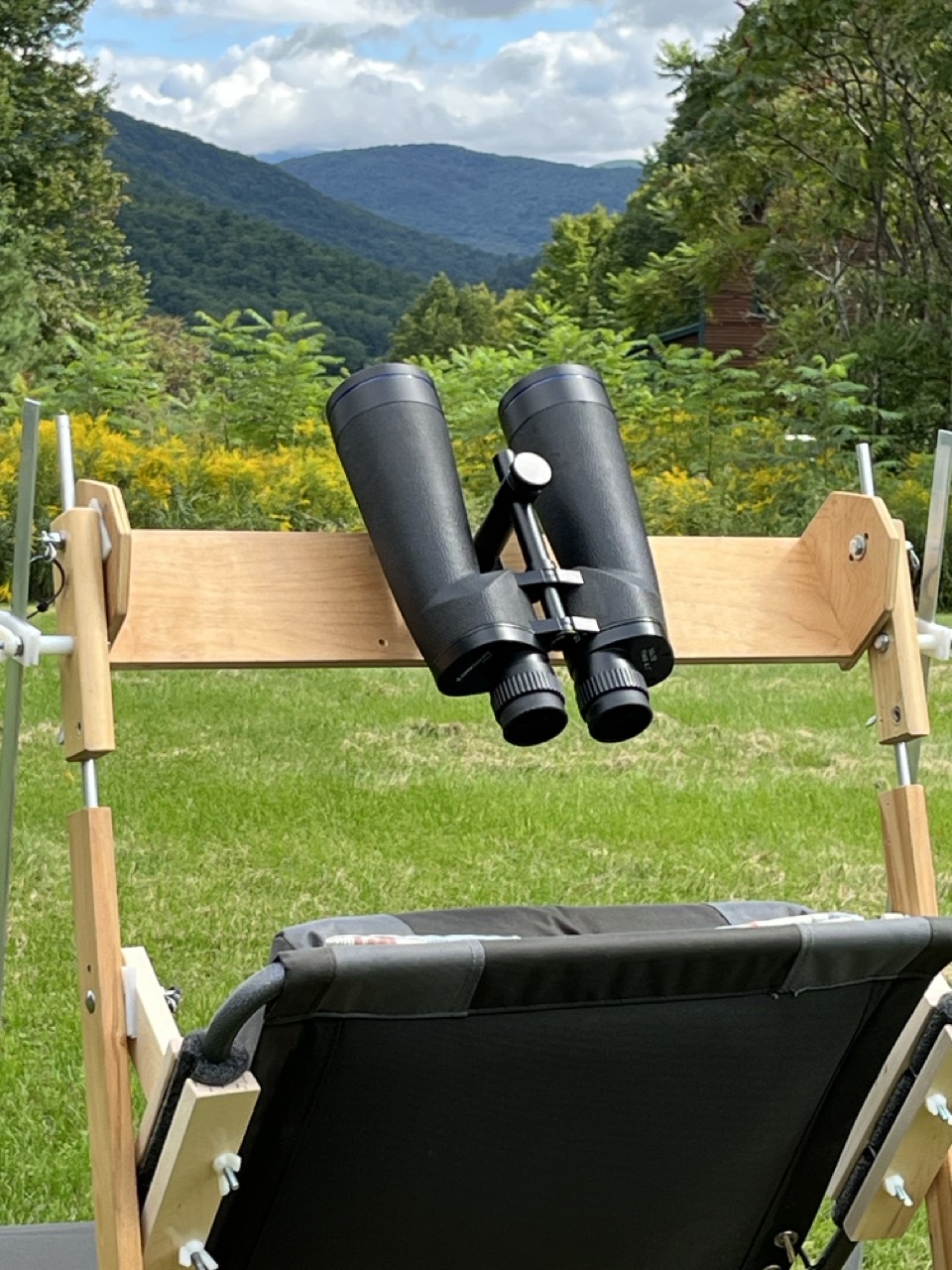
A binocular chair is most suitable for cruising through star fields at up to about 20x.
The Milky Way Lounge zero gravity binocular chair components have been fully tested with 10×50, and with 16×70 (shown here). An 82mm spotting scope, which zooms from 20x to 60x, has also passed our nighttime viewing test nicely. Lightweight 20×80 also perform well.
Aperture: For astronomy, when compared to daytime usage, aperture is of high importance. In general, 50mm lenses are considered to be in somewhat of a sweet spot. As we age, our pupils may not dilate as much at night (younger: ~6-7mm, older ~4-5mm). So for example, by choosing 10×50 rather than 7×50, the 50mm of available light coming into each lens, will be concentrated into smaller exit pupils.
Moderate magnification is also important for astronomy. When attempting to view faint stars, magnification improves contrast by spreading out the light of the background sky. Of course this is a tradeoff with field of view. When using a bino-chair, not only are the binoculars mounted, but one’s head is also resting steady. This helps keep both eyes centered, even with binoculars that have somewhat small exit pupils. Higher magnification binoculars in general tend to have smaller exit pupils, ex: 3mm for 20×60 and 4mm for 20×80.
Focusing: For stargazing with binoculars, most choose individually focusing lenses, which tend to stay in focus1, and are more rugged and waterproof. But these are not as appropriate for daytime use, such as for birding. For combined day and night use, consider binoculars up to 10x that have a central focusing knob which can quickly refocus both lenses together.
Mounting: For mounting on a binocular chair it is convenient if there is a threaded mounting socket at the front between the two barrels. High magnification binoculars over 20x are always more challenging to stabilize on any mounting system. This is also true with a binocular chair. Actually a binocular chair can support these heavier binoculars, but the view through them may have an effect called “heartbeat”. This is where one’s pulse is transmitted through the chair and the mount, and then into the binocular view. For heavier higher magnification binoculars, the traditional mount is a sturdy tripod. Tripods provide stable views, but often at the cost of discomfort, especially when the viewing elevation is increased. The tripod legs can get in the way. If seated when using a parallelogram mount, the chair will need to be constantly repositioned in order to view different portions of the sky comfortably.
A more technical topic: Flat-field astronomy binoculars: Typically, a binocular’s objective lenses form an image across the binocular’s internal focal planes, which can suffer from field curvature. The eyepieces must then project these focal planes into a wide field of view at steep angles, inevitably introducing magnification distortion. Premium astronomy designs use specialized lens elements (field flatteners) to eliminate this field curvature. These binoculars, which correct the edge sharpness, are desirable for sweeping the night sky, like when using a binocular chair. Flat-field binoculars preserve stars as sharp, crisp, pinpoint dots across the entire field of view, creating a highly immersive, distortion-free “spacewalk” experience. This compares to most terrestrial binoculars, which may have an intentional “pincushion distortion” enhancement to counteract the perceived “rolling ball effect” when panning across landscapes. These terrestrial binoculars can still be used for astronomy, but those with intentional pincushion distortion have a distinct disadvantage compared with flat-field models. Some premium daytime binoculars are engineered with field-flattener lenses.
1 when central focusing binoculars are pointed upwards, the constant downward weight of the eyepieces may slowly overcome the friction of the central focusing gear, causing the focus to slip.


Leave a Reply