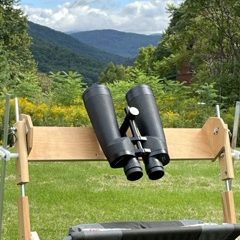
This elevation control provides stable and comfortable viewing all the way up to zenith, when used on a zero gravity chair. Here are the mechanical parts of this award winning binocular chair elevation control component.
Teeter-cradle:
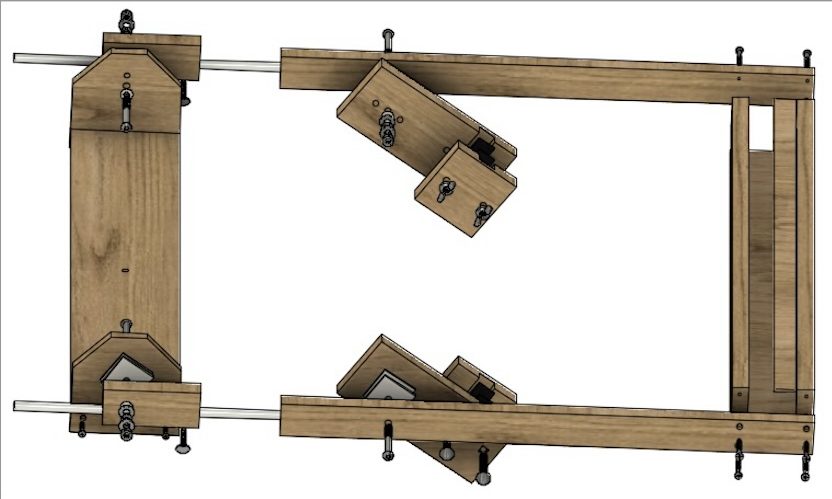
The teeter-cradle is the main elevation control component. The teeter is the seesaw mounted on the chair’s backrest with the teeter mount blocks. When the backrest tilts, the teeter is carried along. The swiveling cradle is mounted on cradle mount blocks, which can slide on the metal tubes at the front ends of the teeter.
Night sky observers are familiar with the term “altitude”, but “elevation” is used here for the same purpose.

Pair of teeter mount blocks, one side of chair
Teeter Mount:
The pairs of wide clamping blocks, one pair on either side of the backrest, have these functions:
- they hold the teeter axles
- they provide adjustable swivel friction for the teeter
- to adjust for user height, clamp the mount at any height on the backrest, using the nylon wingnuts
- for adjusting the depth of the teeter axle from the backrest, use the teeter axle hole options

Cradle mount block, one side of cradle
Cradle Mount:
The two small blocks, one on each end of the cradle, are very multi-functional:
- they hold the cradle axle
- they provide adjustable swivel friction for the cradle
- they provide adjustable cradle distance (depth) from the user
- each can connect to an optional stability rod (see the pic above)
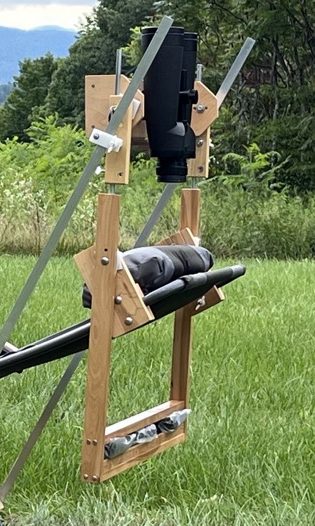
Teeter-cradle for elevation control
Coarse adjustments:
To optimize viewing, coarse adjustments are made beforehand. Very few adjustments are needed while viewing.
| Purpose | Adjustment |
|---|---|
| to adjust for user height | raise or lower the teeter mounts on the chair’s backrest |
| to balance the binocular weight | add to the rear counterweight |
| to coarse adjust the distance from the binoculars to the eyes | slide the cradle mounts forward or back on the metal tubes, and tighten the thumbscrews |
| to match to the binocular center of mass | change the cradle axle position |
| to compensate for neck cushion thickness, head size and eyeglasses | slide the cradle forward or back on the metal tubes |
| to adjust the swiveling friction (aka: stiction), for steady viewing | adjust the axle’s nuts and retainers to change the compression on the friction washers |
Fine control during viewing session:
With one hand, swivel the teeter and the cradle at the same time. This shifts the view up or down and keeps the binoculars at the best distance from the eyes. As an example, raise the teeter and lower the cradle simultaneously, which may result in a better eye-to-ocular relationship. This is a very helpful feature.
Chair-front counterweight:
This balances most of the weight of the loaded teeter-cradle. This means that less force is needed when tilting the backrest in either direction. It also prevents the chair from tipping backwards.
Stability rods:
This option keeps the viewing elevation from drifting, and reduces any vibration.


Leave a Reply